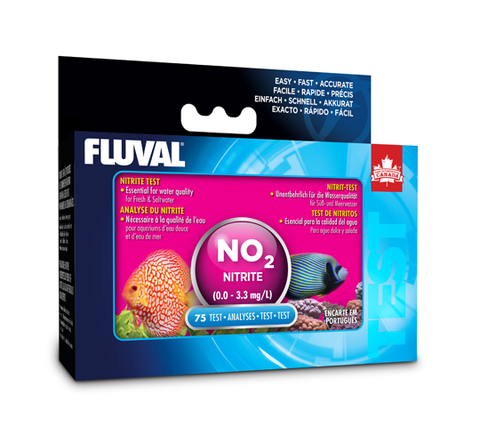
Red Sea Marine Care Nitrite/Nitrate Test 60/100 tests


Red Sea Marine Care Nitrite/Nitrate Test 60/100 tests
Confirm the cycle, then watch the creep. The Red Sea Marine Care Nitrite/Nitrate Test Kit measures nitrite and nitrate in marine and reef aquariums — nitrite to confirm a new tank's cycle has finished, nitrate to track the slow build-up every established marine system eventually has to manage.
Key features
- Two parameters, one box — nitrite (60 tests) and nitrate (100 tests).
- 0–1 ppm nitrite range in 0.05 ppm steps — fine enough to confirm a true zero, not just "close to zero".
- 0–250 ppm nitrate range in 2 ppm steps — covers everything from a pristine reef tank to a badly overdue water change.
- Colorimetric method — add reagent, wait, match against the printed colour card.
Specifications
| Parameter | Range | Resolution | Tests per kit |
|---|---|---|---|
| Nitrite (NO2) | 0–1 ppm | 0.05 ppm | 60 |
| Nitrate (NO3) | 0–250 ppm | 2 ppm | 100 |
Method: colorimetric for both. Water type: marine and reef. Storage: sealed, 15–25°C, use before the expiry date printed on the pack.
What's included / Not included
The kit includes nitrite and nitrate reagents, a glass test vial and printed colour comparison cards for both parameters. It does not include an ammonia, pH, calcium, magnesium or alkalinity test — for the full four-parameter cycling picture, see the Marine Care Multi Test Kit.
Suitable for, and not suitable for
Suitable for any marine or reef aquarium — confirming cycling in a new tank, and tracking nutrient creep in an established one. On its own it's not a complete cycling test, since it doesn't cover ammonia; pair it with an ammonia test during the first three weeks of a new tank.
Target ranges
| Parameter | FOWLR target | Reef target |
|---|---|---|
| Nitrite | 0 ppm | 0 ppm |
| Nitrate | Under 20–40 ppm is generally tolerated | Under 5–10 ppm; SPS-dominated systems are usually kept under 2 ppm |
These are marine and reef target ranges. This kit is formulated for marine use, so no freshwater community, planted or African cichlid target range applies.
What to do when a reading is out of range
Detectable nitrite in an established tank means the biofilter has been disturbed — check filtration, ease off feeding, retest daily until it returns to zero. Elevated nitrate is corrected with more frequent water changes, reduced feeding, and a nutrient export product such as Red Sea NO3:PO4-X or Red Sea NO3/PO4 Reducer media for ongoing control.
Care and storage
Keep sealed, store between 15–25°C out of direct sun, and check the expiry date printed on the pack before trusting an older kit's result.
Warranty and delivery
Covered by the consumer guarantees under Australian Consumer Law, in addition to any manufacturer undertaking. Standard parcel freight — no special handling required.
Goes well with
- Red Sea Marine Care Ammonia Test Kit — the third parameter needed to fully track a new tank's cycle.
- Red Sea Marine Care Multi Test Kit — adds pH and ammonia in the same colorimetric format.
- Red Sea NO3:PO4-X — nutrient export when nitrate reads high.
Common questions
Is a nitrite reading of zero enough to confirm my tank has cycled?
Not on its own — ammonia also needs to read zero on the same day. Test both together during cycling.
How high can nitrate go before it's a problem?
It depends on what's in the tank. Fish-only systems tolerate nitrate into the tens of ppm; SPS coral show stress well before that, which is why reef keepers generally aim to keep nitrate under 5–10 ppm.
Why does this kit include more nitrate tests than nitrite tests?
Nitrite is only critical during cycling and briefly after any biofilter disruption; nitrate gets tested routinely for the life of the tank, so the kit weights the count accordingly — 100 nitrate tests against 60 nitrite.
Does this kit also test ammonia?
No — ammonia is a separate Marine Care kit, or included together with this kit's parameters plus pH in the Multi Test Kit.