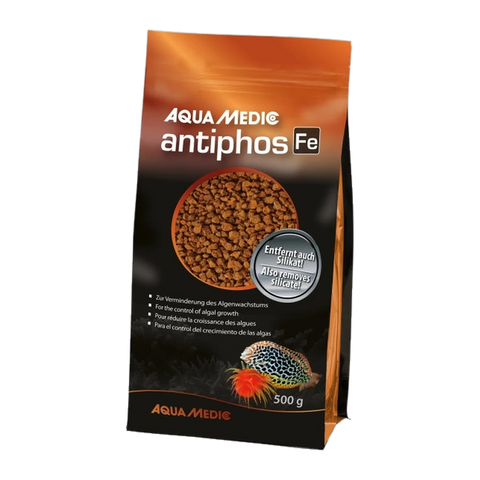
Aqua Medic Antiphos Fe

Water type
Marine + Freshwater
Replace every
3 months
Media type
Iron hydroxide
Aqua Medic Antiphos Fe
Iron-based GFO that strips phosphate before algae gets to use it. Aqua Medic Antiphos Fe is an iron hydroxide filter media that binds phosphate and silicate from aquarium water, starving the nuisance algae that feed on them. It is aluminium-free and safe for fish, invertebrates and plants when run correctly in a reactor or filter bag.
Key features
- Binds phosphate and silicate – removes the two nutrients that drive nuisance and diatom algae growth.
- Aluminium-free iron hydroxide – will not leach aluminium into the water column the way some older GFO media can.
- Fresh or marine – suitable for both, including reef systems.
- Long-lasting capacity – roughly 10 g of phosphate bound per kilogram of media before it is exhausted.
- Two pack sizes – 500 g and 1000 g, to match reactor size and system load.
Specifications
| Variant | SKU | Barcode |
|---|---|---|
| 500 g | AA2595 | 14025901143423 |
| 1000 g | AA2771 | 4025901143430 |
How much tank does a pack cover?
Aqua Medic rates the 500 g pack as sufficient for a 300 L aquarium under normal bioload for approximately three to six months, depending on stocking and feeding. The 1000 g pack carries twice the media by weight; treat that as a larger-system or longer-interval option rather than assuming an exact doubled figure, since binding capacity is also affected by flow rate and how saturated the phosphate load already is.
Setting it up
- Rinse the media before use to clear dust that would otherwise cloud the tank.
- Run it in a fluidised media reactor or a mesh filter bag, in good flow – GFO works by contact, so a reactor that keeps the media gently tumbling outperforms a bag sitting still in a sump corner.
- Replace before it is fully exhausted rather than waiting for phosphate to rebound – test your phosphate level and swap the media once the reading plateaus rather than climbs.
Suitable for, and not suitable for
Suitable for freshwater and marine systems, including reef tanks, where phosphate or silicate is driving algae. Not a fix for an overstocked or overfed tank on its own – it treats the symptom; feeding and stocking are the underlying lever.
Care and maintenance
Test phosphate regularly rather than running to a fixed calendar date – bioload varies run to run. Sudden, heavy dosing of fresh GFO into an already low-phosphate reef tank can drop phosphate too fast for corals used to a higher baseline; introduce a fresh batch gradually if your tank already reads low.
Warranty and delivery
Covered by the manufacturer's standard shelf-life guarantee, in addition to your rights under Australian Consumer Law. Ships standard parcel from North Lakes, QLD.
Common questions
Will this affect my corals?
Used as directed it is safe for reef systems, but drop phosphate gradually if your tank already reads low – corals adapted to a slightly higher baseline can react to a sudden swing.
Reactor or filter bag – which is better?
A reactor that keeps the media tumbling gets more even contact and typically better performance per gram; a filter bag is a reasonable lower-cost option for smaller systems.
How do I know when to replace it?
Test phosphate on a regular schedule. Once the reading stops falling and plateaus, the media is exhausted even if it still looks physically intact.
Does it work in freshwater?
Yes – it is not reef-specific. Freshwater planted and community tanks fighting phosphate-driven algae can run it the same way.