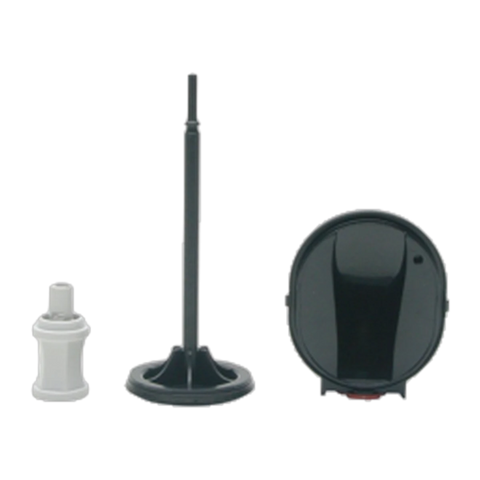
Fluval 07 Motor Head 407

Wattage
20 W
Suits tanks
150–500 L
Flow rate
1450 L/h
Water type
Freshwater + Marine
Fits
Fluval 407 (A449)
Part no.
A20104
Voltage
240 V / 50 Hz
Max head
2.25 m
In the box
1 x motor head with sealed motor, pump housing, mains lead and plug
Pack quantity
Motor head only
Genuine part
Yes, genuine Fluval
Fluval 07 Motor Head 407
Rebuilds the pump end of a 407 without buying a new filter.
The genuine Fluval 407 motor head, part A20104, is the largest of the four 07 heads and the only one rated to 2.25 m of lift. It fits the 407 alone (model code A449) – the 150–500 L canister carrying the range's 1,450 L/h output. Fluval supplies it without the magnetic impeller or impeller cover.
Key features
- Genuine Fluval A20104 – the only 07 head rated to 2.25 m of lift, which is what makes the 407 workable under a tall cabinet.
- Restores 1,450 L/h rated output – 930 L/h with media loaded, the highest in-service flow in the range.
- 20 W sealed motor – double the draw of the 107 and 207 heads, with the largest rotor chamber of the four.
- Freshwater and marine – the wetted parts tolerate saltwater, though salt creep at the head joint needs watching on a reef.
What's included
- 1 x genuine Fluval motor head for the 407, part A20104, with sealed motor, pump housing, mains lead and plug
Not included – read before ordering
Fluval supplies this head bare. A head fitted without an impeller will not pump.
- The magnetic impeller. Order the impeller with ceramic shaft and rubber bushings (A20169), or move the old one across if it is clean and unchipped.
- The impeller cover. See the impeller cover (A20148).
- The motor head gasket. Reusable if still soft, but a head swap is the moment to renew it – see the motor head gasket (A20064).
- The canister, baskets and media. This is the top section only; the canister case for the 407 is separate.
The motor head maintenance kit for the 407 (A20097) covers the wear items in one go.
Specifications
| Manufacturer part number | A20104 |
|---|---|
| Fits | Fluval 407 only (model code A449) |
| Rated capacity of the filter | 150–500 L |
| Pump output restored | 1,450 L/h |
| Filter circulation with media | 930 L/h |
| Maximum head height | 2.25 m |
| Power consumption | 20 W at 230–240 V / 50 Hz |
| Supply | 240 V / 50 Hz, Australian plug |
| Estimated annual power use | 175 kWh run continuously |
| Water type | Freshwater and marine |
| Sold as | Single motor head. No tools required to fit |
Will it fit my filter?
It fits the Fluval 407 and nothing else. Because the 307 and 407 share a canister body, the wrong head is easy to order – check the model code on the compliance label rather than the shape of the canister. It does not fit the 307, 107 or 207, nor the 406, 405 or earlier, nor any FX-series filter. Fluval lists no supersession for A20104.
Which motor head do I need?
The four 07 heads are not interchangeable – each is matched to its own canister and motor rating. The model code is printed on the compliance label under the canister.
| Filter | Model code | Head part | Pump output | With media | Max head | Power at 240 V |
|---|---|---|---|---|---|---|
| 107 | A440 | A20101 | 550 L/h | 360 L/h | 1.45 m | 10 W |
| 207 | A443 | A20102 | 780 L/h | 460 L/h | 1.45 m | 10 W |
| 307 | A446 | A20103 | 1,150 L/h | 780 L/h | 1.75 m | 15 W |
| 407 | A449 | A20104 | 1,450 L/h | 930 L/h | 2.25 m | 20 W |
Performance – what this head actually delivers
Fluval publishes three figures for the 407, describing three different situations. Only the middle one resembles a real installation.
| Condition | Flow | What it means |
|---|---|---|
| 0 m head, no media, no hoses | 1,450 L/h | Pump output – the headline number, and the one condition that never occurs in a running tank |
| In service, media loaded | 930 L/h | Filter circulation – Fluval's figure for the assembled filter, and the one to size a tank against |
| 2.25 m head | 0 L/h | Maximum head height – at this lift the pump can no longer raise water at all |
Fluval publishes no intermediate points, so no curve is reproduced here rather than an interpolated one being invented. Expect flow to fall steadily as lift, hose length and elbow count increase. Note also that Fluval measures output at 120 V / 60 Hz; Australian units run at 240 V / 50 Hz, where the published draw is 20 W.
Suitable for, and not suitable for
Suitable for a 407 with a failed or seizing motor, a cracked pump housing, or persistent leakage from the motor body. Also for marine installations where salt creep has corroded the rotor chamber – the most common way a 407 head dies early.
Not suitable as a cure for a 407 that has outgrown its media schedule, or for one working against more than 2.25 m of lift, which is beyond the pump's rating in any condition.
Safety and maintenance
Supplied for 240 V / 50 Hz with an Australian plug. Unplug at the wall before removing the head, and never power it up with the canister open or dry – the bushings are water-lubricated and a dry start does measurable damage.
The mains lead is moulded into the sealed motor and cannot be replaced separately, so a damaged cord makes the head scrap rather than a repair. Run the filter on an RCD-protected circuit and form a drip loop in the lead. To make the head last, wipe the rotor chamber at every service – grit and calcium there is what scores the chamber and eventually kills the motor – and lubricate the gasket with silicone lubricant, never petroleum jelly.
Goes well with
- 07 output nozzle – for a return jet that has gone brittle or discoloured
- Media basket cover – worth checking while the head is off, since a cracked one lets water bypass the media
- Motor head for the 307 – if the compliance label says you have the other model
Warranty and delivery
Supplied as a genuine Fluval service part. Fluval does not publish a separate warranty term for individual replacement parts; the published warranty attaches to the complete filter. Your rights under the Australian Consumer Law apply in full and nothing stated here limits them. Ships as a standard parcel anywhere in Australia, with no dangerous goods restrictions.
Common questions
Does the Fluval A20104 motor head include the impeller?
No. The A20104 head is supplied without the magnetic impeller and without the impeller cover. The 407 takes impeller A20169, which does not interchange with the 307's.
Will a Fluval 307 motor head fit a 407?
No. The 307 head is a 15 W motor and the 407 head is 20 W. They share a canister body shape but not a part number – check for model code A449 on the compliance label before ordering.
How high can a Fluval 407 pump?
Fluval rates the 407 to a maximum head height of 2.25 m, the highest in the 07 range. At that lift flow has fallen to nothing, so plan an installation well inside the rating rather than at it.
Why did my Fluval 407 motor head fail on a reef tank?
Salt creep is the usual cause. Saltwater wicks into the head joint, crystallises and works into the rotor chamber, abrading the bearing surfaces. Rinsing the joint in fresh water at each service prevents it.